Meeting a Thousand-Year-Old Temple Hidden in Rugged Mountains
5 stops · 5-6 hours
Gimcheon is a sizable city, but it also has rugged terrain rising over 1,000m above sea level. On the slopes of Hwangaksan Mountain stands Jikjisa, a thousand-year-old temple founded by Master Ado; on Sudosan Mountain are Cheongamsa, where Queen Inhyeon is said to have stayed after being deposed, and Sudoam Hermitage, known for its beautiful views. Near the entrance to Jikjisa are also the pleasant Jikji Culture Park, the World Ceramic Museum, and the Baeksu Literature Museum, all worth a visit.
- Duration
- 5-6 hours
- Distance
- 46.1km
Along the way
- 1
Jikjisa Temple
직지사
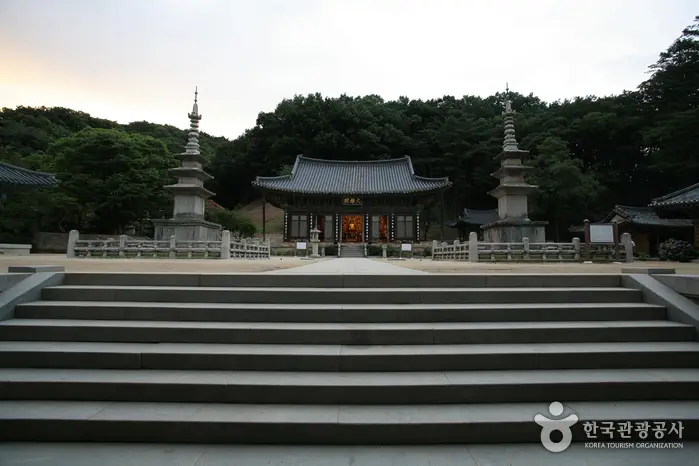
Located 12km west of Gimcheon Station at the foot of Hwangaksan Mountain, Jikjisa was built in 418 (the second year of King Nulji of Silla) by Master Ado. The lush old pine trees around the temple, the clear water of the deep valley, and the autumn foliage create a spectacular scene that blends beautifully with the surrounding landscaping. On the grounds is Birojeon Hall (also called Cheonbuljeon, or Hall of a Thousand Buddhas), where 1,000 small Buddha statues are enshrined side by side; there is also the Ilju-mun gate, with pillars made from a thousand-year-old arrowroot vine and bush clover wood, Daeungjeon Hall, a representative Joseon-era building, and a 1.63m-tall seated stone Medicine Buddha (Bhaisajyaguru) from the Unified Silla period, Treasure No. 319. Meanwhile, an international Buddhist training center capable of accommodating 5,000 people was completed in May 1994.\nMoreLess
- 2
Jikji Culture Park
직지문화공원
A park in Gimcheon, Gyeongsangbuk-do, created to prevent haphazard development in the surrounding area, preserve the traditional temple, develop tourism resources, and provide a resting space for citizens. Centered on a musical fountain sculpture, Jikji Culture Park includes general park facilities such as three plazas; a large two-tiered waterfall 25m wide and 17m high; a 330m stream facility that channels the clear water from within Jikjisa's grounds directly into the park; ten types of children's play facilities; a 3,600m walking trail made up of an acupressure path, decomposed granite, and clay blocks; pavilions and pergolas of various designs; and benches and other amenities for resting.\nMoreLess
- 3
Gyeongdong Wild Greens Restaurant
경동산채식당
This restaurant has specialized in wild-greens cuisine for 35 years. It sources wild greens to make various sashimi-style dishes and seasoned side dishes, with the menu changing by season (wild greens in spring, mushrooms in autumn). Rice is cooked using Taprice brand rice for guests. It was designated Model Restaurant No. 1 in 1979 and has also appeared on KBS.\nMoreLess
- 4
Cheongamsa Temple
청암사
Cheongamsa was founded in 858 (the second year of King Heonan of Silla) by Doseon. At the time of its founding, Hyecheol (785–861), founder of the Dongni-san school of the Nine Mountain Seon Schools, is said to have stayed there. It burned down completely in a fire in 1647 (the 25th year of King Injo of Joseon); upon hearing the news at Deogyusan Mountain, Master Byeogam Seongchong had his disciple, Master Heojeong, rebuild Cheongamsa, and Master Heojeong devoted great effort to its reconstruction. This is referred to as the temple's second rebuilding.\nMoreLess
- 5
Sudoam Hermitage (Gimcheon)
수도암(김천)
Sudoam is a place of practice located in the upper reaches of Sudosan Mountain (1,317m above sea level). According to legend, National Preceptor Doseon, upon seeing this site, predicted that countless practitioners would emerge from it in the future, and so named the mountain and the hermitage Sudosan and Sudoam, respectively. However, for the past hundred-odd years, people have also come to call it Buryeongsan, owing to the many stories of the Buddha's miraculous power and wonders associated with the site.\n\nMoreLess
Source: Korea Tourism Organization (TourAPI) · Machine-translated