The Path to the Buddha's True Relics
4 stops · 5 hours
Tongdosa is a bulbo temple, one of Korea's three jewel temples, and a major temple complex. It was founded by Master Jajang, who enshrined the Buddha's true relics (sarira) and robe there. Across from Yeongchuksan Mountain, where Tongdosa is located, Naewonsa and Hongnyongsa temples nestle in the folds of Gajisan and Cheonseongsan mountains. Naewonsa has the beautiful Naewonsa Valley, and Hongnyongsa has the lovely Hongnyong Falls, making this a journey that offers both temple visits and spectacular scenery.
- Duration
- 5 hours
- Distance
- 28.9km
Along the way
- 1
Tongdosa Temple
통도사
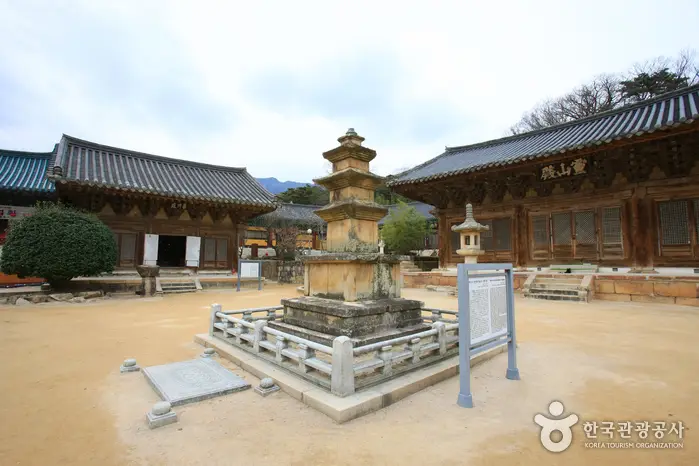
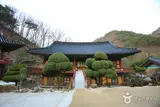
One of Korea's three great temples, Tongdosa is also called a 'bulbo' (Buddha-jewel) temple because it houses the Buddha's true relics (sarira). Based on records such as the Samguk Yusa, Tongdosa is believed to have been founded by Master Jajang during the reign of Queen Seondeok of Silla. The temple's name comes from the fact that the shape of the mountain where the temple stands resembles Yeongchwisan (Vulture Peak) in India, where the Buddha preached (此山之形通於印度靈鷲山形); it is also said to mean that anyone wishing to become a monk must pass through this ordination platform (爲僧者通而度之); and it is said to derive from the idea of comprehending all truths and saving all sentient beings (通道).\nMoreLess
- 2
Gyeonggi Restaurant
경기식당
Located at the entrance to the mountain gate of Tongdosa, one of Korea's three great temples and a bulji daechal (great temple of the Buddha-jewel), this restaurant is known to visitors for its clean, appetizing dishes made with wild greens and deodeok (bellflower root) purchased directly from nearby Eonyang, Ulsan.\nHere you can also taste the delicacies of Yeongchuksan Mountain, rich in wild greens. Yeongchuksan yields wild pine mushrooms in autumn and wild greens such as chamnamul, gomchi, and sancho leaves in spring, making it well worth visiting along with the ancient pine forests of Tongdosa. The restaurant's soybean paste and red pepper paste are aged in old earthenware jars for a rich flavor, and their sun-ripened taste is excellent.\nMoreLess
- 3
Hongnyongsa Temple
홍룡사
Hongnyongsa sits in the valley of Cheonseongsan Mountain, 'where a thousand sages appeared.' Around the mountain are Tongdosa and Naewonsa, both ancient Silla temples, but one is the head temple of a Jogye Order district and the other a training center for Buddhist nuns, so ordinary visitors do not linger easily at either. Hongnyongsa, by contrast, offers both Buddhist practitioners and ordinary visitors a bit of breathing room in life, a place to set down the burdens of the secular world for a while. At Hongnyongsa — whose name is interpreted as 'the rainbow that blooms as water falls' — a sense of detachment from worldly attachment arises naturally. It seems to come less from the Seon meaning of 'mindfulness of enlightenment' and more from a state of settled, quiet peace — in other words, a resonance with the feeling of not welcoming the restlessness of worldly currents.\nMoreLess
- 4
Naewonsa Temple
내원사
Naewonsa is a branch temple of Tongdosa, the head temple of the 15th district of the Jogye Order of Korean Buddhism, located at the foot of Cheonseongsan Mountain — called the 'second Geumgangsan' for its stunning scenery and beautiful 6km valley. It was founded some 1,300 years ago by Master Wonhyo during the reign of Queen Seondeok of Silla.\nMoreLess
Source: Korea Tourism Organization (TourAPI) · Machine-translated