Driving Along Mulmi Coastal Road, Gazing at the Sea
7 stops · 7 hours
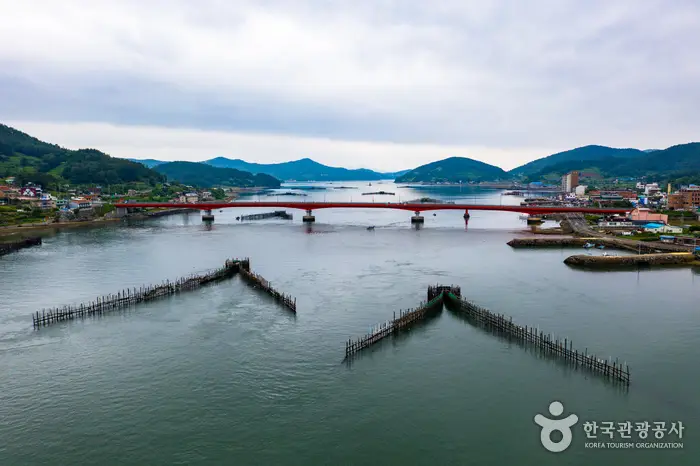
Cross the Samcheonpo Bridge to reach Namhae, and along Mulmi Coastal Road, running from Mulgeon-ri to Mijo-ri, the blue sea shines like a jewel. Along the Jijok Strait, the jukbangnyeom (bamboo stake-net traps), also called daenamueosari, produce what is considered the finest anchovies in Korea. Along Mulmi Coastal Road, there are quite a few places worth visiting along the coast, including German Village, Wonye Art Village, and the Mulgeon-ri Coastal Fish-Shelter Forest.
- Duration
- 7 hours
- Distance
- 41.6km
Along the way
- 1
Changseon Bridge and Jukbangnyeom
창선교와 죽방렴
Twice a day, when it passes noon, the Jijok Strait begins to churn roughly. This is because when the tide turns between ebb and flow, seawater rushes through the narrow strait with a current too powerful to withstand. Changseon Bridge crosses this same Jijok Strait, connecting Jijok-ri in Changseon-myeon with Jijok-ri in Samdong-myeon. Measuring 438m long and 14.5m wide, it opened on December 20, 1995. The original Changseon Bridge, completed on June 5, 1980, collapsed in 1992 and was rebuilt as the current bridge.MoreLess
- 2German Village
독일마을
In order to support the resettlement of Korean expatriates living in Germany who had devoted themselves to national modernization and economic development during the difficult 1960s, and to give them a warm place to feel their homeland's affection while developing a distinctive tourist destination linking German exotic culture with a traditional culture and arts village, Namhae-gun began development in 2001 on a 99,174㎡ (about 30,000-pyeong) site in Mulgeon-ri, Samdong-myeon, Namhae-gun — home to Natural Monument No. 150 — investing over 3 billion won to build infrastructure and sell house lots for around 70 homes. The expatriates directly imported materials from Germany to build traditional German-style houses; today about 15 houses have been completed and are inhabited by Korean-German residents, some of whom also run them as guesthouses for tourists while they are away in Germany. Just in front lies the refreshing sea framed by the Bangjoeobulim coastal forest, and Mulmi Coastal Road, the most beautiful coastal drive in the South Sea region.MoreLess
- 3
Wonye Art Village
원예예술촌
Wonye Art Village, House N Garden, was created by television actress Park Won-sook together with fellow horticulture enthusiasts who shared a lifelong dream of building a beautiful garden and a pretty village. They built their houses and gardens hoping that someone would one day discover in this place the very home and garden they too had once dreamed of. After years of effort, individual gardens themed around fragrance, palm trees, stone sculptures, topiary, vegetables, windmills, spas, and flower roofs have been beautifully completed, along with paths, ponds, an observation deck, an octagonal pavilion, a fountain, flower-lined walkways, flower hedges, and a greenhouse. Though it still needs a little more time to fully mature, it is offered as a proposal for a green lifestyle for modern people. It is also well equipped with a state-of-the-art screening room, performance hall, exhibition hall, experience room, cafe, and guesthouse for visitors' convenience.MoreLess
- 4
Haesarang Abalone Village
해사랑전복마을
Driving along the coastal road while taking in the scenery of Namhae, just before reaching the end of the road at Mijo Port, you'll come upon Haesarang Abalone Village. Stepping through the restaurant's door, warm sunlight streams in through windows on every side, and a charming, picture-like view unfolds before your eyes. It is also a well-known restaurant that received a Blue Ribbon in Korea's first restaurant evaluation guide, the 'Blue Ribbon Survey.' The owner also runs Saranghae Pension, 50m away.MoreLess
- 5Sangju Silver Sand Beach
상주 은모래비치
Towering black pines and the deep-blue sea rolling in — the true scenery of Namhae. Located in Sangju-myeon, Namhae-gun, South Gyeongsang Province, Sangju Beach is known for its unusually white sand, surrounded by a dense pine forest. It is the most famous beach in Namhae, drawing a steady stream of visitors year after year. The scenic peaks of Namhae Geumsan wrap around both sides and the rear of the beach like a folding screen, and the seawater is especially clear and blue, giving it the look not of an ocean but of one beautiful lake. With its very gentle, shallow slope and warm water temperature, it offers ideal conditions for family vacations with children.MoreLess
- 6Boriam Hermitage on Geumsan
금산 보리암
In 683, after Great Master Wonhyo built a hermitage here and, through his ascetic practice, attained a vision of Avalokiteshvara (Gwanseeum Bosal), he named the mountain Bogwangsan and the hermitage Bogwangsa. Later, it is said that Yi Seong-gye (founder of Joseon) prayed here for 100 days before founding the Joseon dynasty; in gratitude, King Hyeonjong in 660 designated the temple as a royal votive temple, renaming the mountain Geumsan and the temple Boriam. Sitting atop Geumsan, Boriam is a beautiful temple offering sweeping views of Geumsan's many curious rock formations and the blue scenery of Namhae. Within its grounds, Jwaseondae Rock, where Great Master Wonhyo is said to have meditated, draws attention, and nearby, the rock cave known as Ssanghongmun is renowned as the finest of Geumsan's 38 scenic sights. Along with Hongnyeonam Hermitage at Naksansa Temple in Gangwon Province and Bomunsa Temple on Ganghwado in Incheon, it is counted as one of Korea's three great prayer sites, drawing a continuous stream of worshippers.MoreLess
- 7
Namhae Geumsan Beacon Mound
남해 금산 봉수대
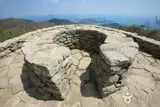
Bongsu was a communication system of earlier times used to convey urgent news by signaling with torches (bong) at night and smoke (su) by day from atop high mountains. This system was first implemented for the military purpose of warning against enemy invasion. In Korea's records, this system appears from the mid-Goryeo period (12th-13th century), but it is presumed to have actually been used even before the Three Kingdoms period. The Geumsan Beacon Mound here was established during the reign of King Uijong of Goryeo (r. 1147-1170) and continued in use through the Joseon dynasty. Among the five main beacon routes of the Joseon period, this beacon belongs to the second route connecting Dongnae to Seoul, and is its southernmost point. Beacon fires lit here were relayed through Daebangsan on Changseon Island, then through Sacheon and Jinju, before reaching Seoul.MoreLess
Source: Korea Tourism Organization (TourAPI) · Machine-translated