Meeting Gaya, the Central Iron-Age Culture
4 stops · 7 hours
Gimhae is the home of Gaya, a kingdom whose history has largely been lost to time. After King Suro founded Garakguk in the Gimhae area in 42 CE, the kingdom grew significantly on the strength of its rich iron culture until it was annexed by Silla in 532. From the Tomb of King Suro and the Tomb of his Queen Consort, which reveal the founding history of Garakguk, to Daeseong-dong Tumuli, bearing traces of Gaya's status as the central power of its confederacy, and the Bonghwang-dong Site, which tells the story of how Gaya became a great maritime power on the strength of its iron culture, visitors can fully experience the history of Gaya centered around downtown Gimhae.
- Duration
- 7 hours
- Distance
- 11.6km
Along the way
- 1
Eunhasa Temple
은하사
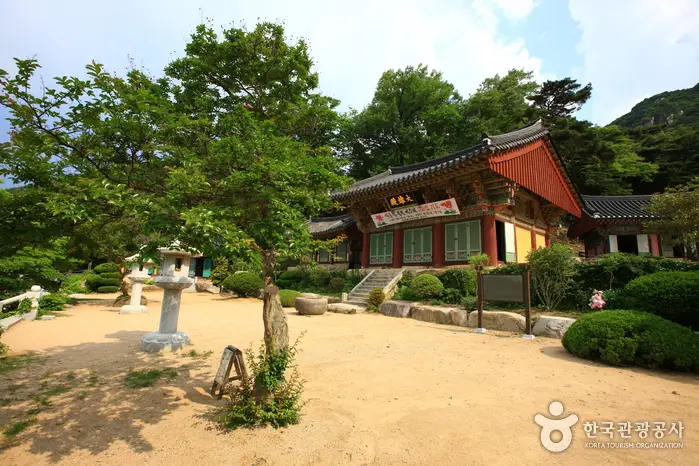
Located on the western slope of Sineosan in Sambang-dong, Gimhae. It is said that the old name of Sineosan was Eunhasan. The founding date of the temple is unclear. According to legend, it was founded by Master Jangyu, elder brother of Heo Hwang-ok, queen consort of King Suro, founder of Garakguk, under the original name Seorimsa. However, since the legendary founding date falls in the 1st century CE, before Buddhism's transmission to Korea, it is generally regarded as legend. If the legend were true, it would be the oldest temple in Korea, at over 1,900 years old. Based on pottery fragments excavated at the temple, it is also estimated to have been founded during the Three Kingdoms period. MoreLess
- 2Daeseong-dong Tumuli
대성동고분
The Daeseong-dong site is located at the center of the Hoehyeon-ri shell mound, famous for Gujibong Peak — associated with the founding legend of Gaya — and the Gimhae shell mound, with the Tomb of King Suro adjoining it to the east. That is, it is centered on a hill 22.6m in elevation called 'Wae(ae)kkoji,' directly behind and north of the public stadium. Excavations conducted here in three phases from 1990 to 1992 by the Kyungsung University Museum determined the site to be a communal burial ground for the ruling class of Geumgwan Gaya. On the well-situated ridge of the hill are the tombs of kings and corresponding rulers, while tombs of lower-status individuals were arranged on the slopes. MoreLess
- 3Tomb of King Suro
수로왕릉
King Suro ascended the throne in 42 CE as the founder of Garakguk, and in 48 CE took as his queen consort Heo Hwang-ok, a princess of Ayuta (Ayodhya) in India; he is the progenitor of the Gimhae Kim clan. The royal tomb was renovated into its present form in 1580 (the 13th year of King Seonjo) by Heo Yeop, the Governor of Yeongnam. Within the tomb grounds are several buildings, including Sungseonjeon Shrine, which enshrines the spirit tablets of King Suro and his queen consort, as well as Anhyanggak, Jeonsacheong, and Jegigo, along with stone structures such as a sindobi stele and a monument to his achievements. The gravestone in front of the tomb was erected in 1647 (the 25th year of King Injo of Joseon), and the name 'Sungseonjeon' was bestowed by the king in 1884 (the 21st year of King Gojong). MoreLess
- 4Sureungwon Garden
수릉원
A forest between the Tomb of King Suro and the Daeseong-dong Tumuli, envisioned as a garden-like space where King Suro and Queen Heo once walked together, its name carries the meaning of an elegant forest connecting the Tomb of King Suro with the Daeseong-dong Tumuli, burial ground of the Gaya kings. Because the former public stadium site had cut off the surroundings of important Gaya-era cultural assets — the Tomb of King Suro, the Daeseong-dong Tumuli (burial ground of the Gaya kings), and the Bonghwang-dong Site — Sureungwon was created there as a gently rolling ridge planted with native tree species and pines, naturally linking the sites together. Built around the theme of the meeting of King Suro and Queen Heo, it forms a 39,600㎡ ecological park. MoreLess
Source: Korea Tourism Organization (TourAPI) · Machine-translated