Cooling Your Feet in a Scenic Valley Stream
5 stops · 7 hours
Goesan is a county known for its striking mountain scenery and clear, clean valleys, including Ssanggok, Gallon Valley, Hwayang-gugok, and Seonyu-gugok. Among these, the especially beautiful Hwayang-gugok and Seonyu-gugok are also well known as the place where the scholar Uam Song Si-yeol lived in seclusion in his later years. Time spent among the striking rock formations and clear streams of the valleys washes the mind as clean as the water itself.
- Duration
- 7 hours
- Distance
- 20km
Along the way
- 1
Hwayang-gugok
화양구곡
Incorporated into Songnisan National Park in 1975, Hwayang-gugok is located 32km east of Cheongju. In the mid-Joseon period, the scholar Uam Song Si-yeol lived here in seclusion and, following the model of China's Wuyi-gugok, is said to have named the nine scenic spots of Hwayang-dong: Gyeongcheonbyeok, Unyeongdam, Eupgungam, Geumsadam, Cheomseongdae, Neungundae, Waryongam, Haksodae, and Pacheon\nMoreLess
- 2
Chaeunsa Temple
채운사
Located on the mountainside past Amseojae, one of the nine scenic spots of Hwayang-gugok, this temple was founded in 1277, the 3rd year of Goryeo King Chungnyeol, by the monk Doil, and rebuilt in 1610, the 2nd year of Joseon King Gwanghae. Through its long history it has been repainted with fresh dancheong coloring. This old temple, nestled amid the striking scenery of Hwayang-dong's nine scenic spots, is surrounded by dense pine, oak, and sawtooth oak forests forming a beautiful setting, and is also used as a forest-bathing site.\nMoreLess
- 3
Historic Sites of Song Si-yeol, Goesan
괴산 송시열 유적
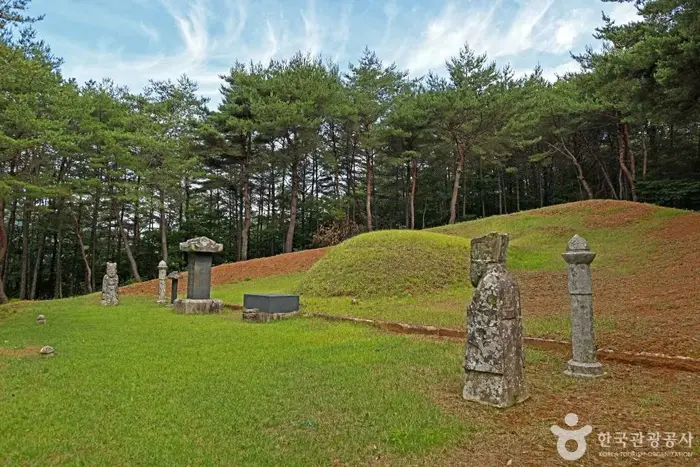
The historic sites of Uam Song Si-yeol in Cheongcheon are centered on the sites of Hwayang Seowon and Mandongmyo Shrine within Hwayangdong Valley, and comprise a group of sites associated with Song Si-yeol, including Amseojae, Eupgungam, an inscribed cliff record, his tomb, and a memorial stele.MoreLess
- 4
Historic Sites of Uam Song Si-yeol
우암 송시열 유적
The historic sites of Uam Song Si-yeol in Cheongcheon are centered on the sites of Hwayang Seowon and Mandongmyo Shrine within Hwayangdong Valley, and comprise a group of sites associated with Song Si-yeol, including Amseojae, Eupgungam, an inscribed cliff record, his tomb, and a memorial stele.MoreLess
- 5
Gongnimsa Temple
공림사
Gongnimsa, nestled beneath Mt. Nagyeongsan, is known as an old temple founded by the monk Jajeong during the reign of Silla's 48th King Gyeongmun (861-874). It is said that when King Gyeongmun learned of Jajeong's spiritual power, praised widely among the people, he honored him with the title of State Preceptor (guksa) and bestowed a plaque naming the temple Gongnimsa. In the mid-Joseon period the temple is said to have flourished even more than Beopjusa, but it burned down in war and stands today as a recently rebuilt structure. \nMoreLess
Source: Korea Tourism Organization (TourAPI) · Machine-translated