Tales of Baekje at the Bear Shrine
4 stops · 4 hours
Gongju, Baekje's second capital, was the kingdom's seat of power for some 60 years -- its golden age -- before the capital was moved again to Buyeo. The Tomb of King Muryeong is one of the few royal tombs in Korea whose occupant has been definitively identified, and it yielded a vast trove of relics that had lain undisturbed for over a thousand years. Gomnaru, the site from which Gongju's old name "Ungjin" derives, is lined with old pines along the riverbank near the Bear Shrine, making for a pleasant walk.
- Duration
- 4 hours
- Distance
- 3km
Along the way
- 1
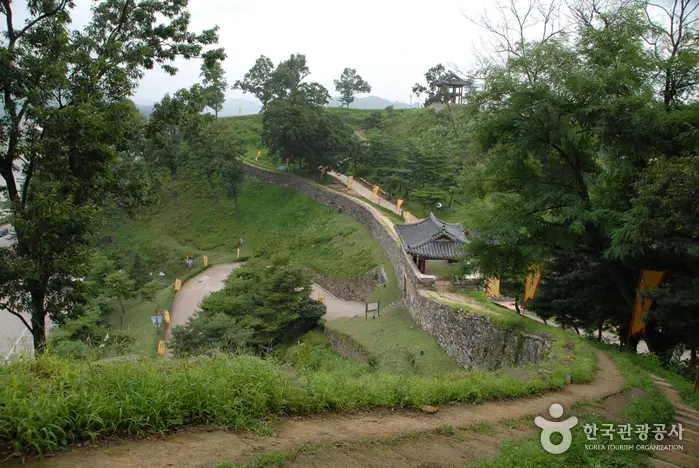
Gongsanseong (Gongsanseong Fortress, Gongju)
공산성(공주 공산성)
Located in Sanseong-dong, downtown Gongju, Gongsanseong was built to protect Gongju, which served as the Baekje capital for five generations and 64 years, from the time the capital moved from Hansanseong to Ungjin in the 1st year of King Munju (475) until the capital moved again to Buyeo in the 16th year of King Seong (538). Historic Site No. 12, Gongsanseong is an ancient fortress with a total length of 2,660m, occupying a naturally strategic position on a ridge 110m above sea level.\nMoreLess
- 2
Lunch (Gomanaru Dolssambap)
점심식사(고마나루돌쌈밥)
Featuring 20 to 30 kinds of rare vegetables and medicinal herbs not easily found elsewhere, this is a healthy meal said to help prevent and treat various lifestyle diseases. \n* Info : 041-857-9999\nMoreLess
- 3Songsan-ri Tomb Cluster (Songsan-ri Tombs and Tomb of King Muryeong)
송산리고분군(송산리 고분군과 무령왕릉)
Among the Songsan-ri tombs (Historic Site No. 13) in Gongju, South Chungcheong Province -- representative Baekje-era remains -- the roughly 1,400-year-old Tomb of King Muryeong, even after 25 years open to the public following its excavation, showed signs of microbial growth such as lichen and water seepage that threatened to damage the original structure. So, in November 1997, after repair work, the tomb, along with the nearby Tombs No. 5 and 6, was permanently sealed off in order to preserve the original state of the Songsan-ri tomb cluster for future generations. \nMoreLess
- 4
Gomanaru
고마나루
Gomnaru, as the Sino-Korean name "Ungjin" (熊津, "Bear Ford") suggests, has a close connection to Gongju; the site refers to the low hilly area and the banks of the Geumgang River west of the Tomb of King Muryeong in Ungjin-dong, Gongju. \nMoreLess
Source: Korea Tourism Organization (TourAPI) · Machine-translated