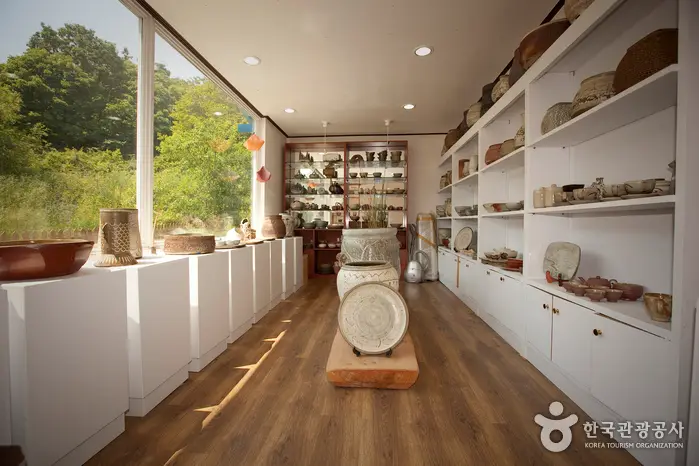
Enjoying a Pottery Experience at Mt. Gyeryongsan
4 stops · 5 hours
Mt. Gyeryongsan, whose name derives from its resemblance to a dragon wearing a rooster's comb, is designated a national park and holds a wealth of cultural heritage and stories throughout its slopes. It has been a storied mountain since ancient times -- so much so that the Joseon dynasty once considered building its capital centered on Gyeryongsan. Explore the Buddhist heritage at venerable temples such as Gapsa, Sinwonsa, and Donghaksa, and enjoy a distinctive pottery experience at Gyeryongsan Ceramic Village, which carries on the tradition of iron-brushed buncheong ware.
- Duration
- 5 hours
- Distance
- 30km
Along the way
- 1Gyeryongsan Ceramic Village
계룡산 도예촌(계룡산도예마을)
In 1993, 18 young potters in their 30s to early 40s, all trained in ceramics at university, joined together to form this community village. They built earthen-walled houses roofed with woven bamboo eaves and gathered here to fire pottery. The potters work together to restore and carry forward iron-brushed buncheong ware, once made at the Gyeryongsan-rok kiln sites in the 15th century. \nMoreLess

- 2Gapsa Temple
갑사
The iron flagpole and its supporting pillars at Gapsa, Treasure No. 256, are a pole for flying a banner (dang) and its stabilizing posts. A danggan is a flagpole erected in front of a temple to fly a banner symbolizing the authority and merit of the Buddha or a bodhisattva and to ward off evil; the danggan-jiju are the two supporting posts on either side that hold the pole upright. \nMoreLess
- 3
Sinwonsa Temple
신원사
Sinwonsa (新元寺), along with Donghaksa and Gapsa, is one of the three great temples of Mt. Gyeryongsan, located in Yanghwa-ri, Gyeryong-myeon, Gongju. It is said to have been founded in the 11th year of Baekje King Uija (651) by the eminent monk Bodeok, and was rebuilt several times afterward -- restored by the monk Boryeon in 1876 and repaired by the monk Manheo in 1946, remaining as it is today.\nMoreLess
- 4
Jungakdan Shrine (Jungakdan of Mt. Gyeryongsan, Gongju)
중악단(공주 계룡산 중악단)
This is the mountain-spirit shrine (sansingak) of Sinwonsa Temple, built in 1394, the 3rd year of King Taejo of Joseon. The mountain spirit was originally a deity guarding the land of mountains, rivers, and earth, and the mountain-spirit rite was, in later times, an outgrowth of the Palgwanhoe rite, once held to uplift the national spirit and pray for the unity and prosperity of all the people, which came to be called rain-prayer rites (giuje) and mountain-spirit rites (sansinje). \nMoreLess
Source: Korea Tourism Organization (TourAPI) · Machine-translated