Where the Architects of Unified Silla Lie at Rest
3 stops · 6 hours
West of the Hyeongsan River, which runs through Gyeongju, the area sees far fewer visitors than downtown. Yet it is here that the key figures of Unified Silla, such as King Taejong Muyeol and General Kim Yu-sin, lie buried. From here you can also take in the sweeping view of the ridgelines of distant Namsan and Mt. Tohamsan.
- Duration
- 6 hours
- Distance
- 7km (incl. 3km to Seondosan)
Along the way
- 1Tomb of Kim Yu-sin, Gyeongju
경주 김유신 묘
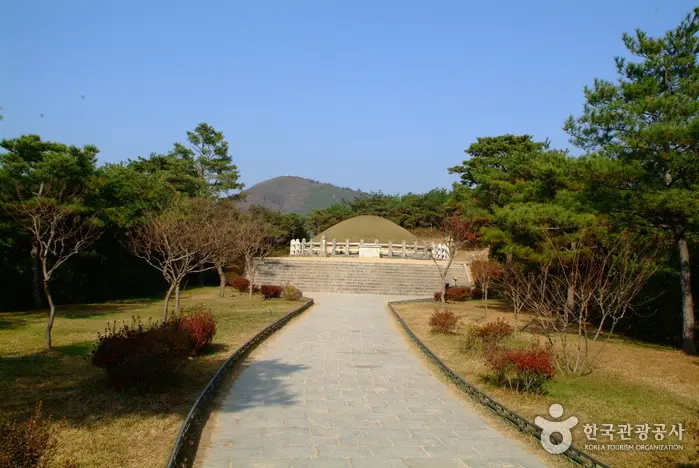
Just past Seocheon Bridge beside the Gyeongju Express Bus Terminal, a road to the right leads to the tomb of General Kim Yu-sin. This road, Heungmu-ro, was built specifically for access to the tomb, and in spring, when forsythia and cherry blossoms bloom brightly along its edges, it is a popular scenic drive. \nMoreLess
- 2
Seoak-ri Tomb Cluster
서악리고분군
Historic Site No. 142, covering 1,930 square meters. On the slope behind the tomb of King Muyeol are four earthen burial mounds arranged in a single line, upper and lower, each roughly 40m across at the base and about 25m high. \nMoreLess
- 3Tomb of King Muyeol and Stele of King Taejong Muyeol, Gyeongju
경주 무열왕릉, 태종무열왕릉비
The tomb of King Muyeol in Gyeongju is the burial place of Silla's 29th ruler, King Taejong Muyeol (r. 654-661, born Kim Chun-chu). It sits at the end of a ridge extending south from Mt. Seondosan, northwest of Gyeongju. Kim Chun-chu, the first king of true-bone (jin-gol) lineage in Silla's mid-period, allied with Tang China to absorb Baekje and laid the foundation for the unification of the Three Kingdoms, but died before completing the unification. The tomb is relatively large, with a base circumference of 114m and a height of 8.7m; the base was originally built up with natural stones supported here and there by larger stones, though it is now buried beneath earth. To the east stand a stone tortoise base and capstone that once held a stele; carved into it is the inscription "Stele of the Great King Taejong Muyeol" (太宗武烈大王之碑), written by Kim In-mun, the king's second son, confirming this as King Muyeol's tomb.\nMoreLess
Source: Korea Tourism Organization (TourAPI) · Machine-translated