Climbing the Buddhist Land of Namsan to Look Down Over Gyeongju
7 stops · 6 hr 30 min
Gyeongju's Namsan is not only designated a national park but is, as the saying goes, "you cannot speak of Gyeongju without having climbed Namsan" -- an essential stop for exploring Gyeongju's cultural heritage. Passing through Oreung, Najeong, Poseokjeong, and Samneung, you climb to the summit, encountering the Silla people's Buddhist land, built up bit by bit on Namsan. It is a path to the essence of Buddhist culture, refined over a thousand years by the Silla people's aspiration for a Buddhist paradise.
- Duration
- 6 hr 30 min
- Distance
- 9.5km (incl. 4.2km climb up Namsan)
Along the way
- 1Oreung Tombs, Gyeongju
경주 오릉
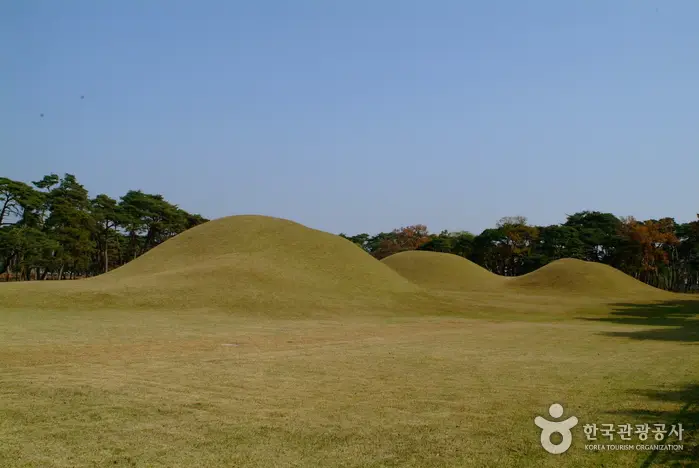
Historic Site No. 172, Oreung (\"Five Tombs\") is said to enshrine together the founding king of Silla, Bak Hyeokgeose, and Queen Aryeong, along with the second King Namhae, third King Yuri, and fifth King Pasa -- four early Bak-clan kings and one queen -- hence the name \"Five Tombs.\" To the east of Oreung stands Sungdeokjeon Shrine, still housing the ancestral tablet of the founding king, and behind it, well preserved, is Aryeongjeong Well, said to be the birthplace of Queen Aryeong. \nMoreLess
- 2
Najeong Well, Gyeongju
경주 나정
Looking southeast from Oreung, amid a thick pine forest, stands a small memorial pavilion, beside which is a well called Najeong (蘿井). Legend holds that Silla's founding king, Bak Hyeokgeose, was born at this well site. \nMoreLess
- 3
Poseokjeong, Gyeongju
경주 포석정
Poseokjeong was one of the detached palaces where the king enjoyed drinking wine; the buildings no longer survive, but a stone channel shaped like a dried abalone (poeo) remains, believed to date from the Unified Silla period. The exact date of its construction is unknown. \nMoreLess
- 4
Stone Standing Buddha Triad at Bae-dong, Gyeongju
경주 배동 석조여래삼존입상
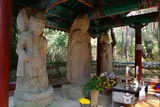
The three stone Buddhas here stand adjacent to Sambulsa Temple on the western slope of Namsan, Gyeongju. They had been lying scattered near the site of the former Seonbangsa Temple, and were gathered and re-erected in 1923. \nMoreLess
- 5
Samneung Tombs, Bae-dong, Gyeongju
경주 배동 삼릉
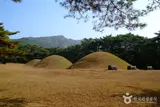
Here lie together the tombs of the 8th Silla King Adalla, the 53rd King Sindeok, and the 54th King Gyeongmyeong, so the site is called Samneung ("Three Tombs").\nMoreLess
- 6Gyeongju National Park
경주 국립공원
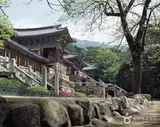
Unlike Seoraksan National Park or Hallyeohaesang National Park, which are defined by mountains or sea, Gyeongju National Park is a park built around a world-renowned body of cultural heritage rather than natural scenery. Gyeongju, where Silla's thousand years of splendid culture flourished, holds the traces of the brilliant national culture left by our ancestors and the grand spirit of the unification of the Three Kingdoms, and everywhere you go it preserves scenic and historic sites, legends, and folk traditions -- a representative destination of Korean tourism.\nMoreLess
- 7
Three-Story Stone Pagoda at Yongjangsagok, Namsan, Gyeongju
경주 남산 용장사곡 삼층석탑
The three-story stone pagoda of Yongjangsagok on Namsan omits a lower platform tier, instead cutting a single 6m-high stepped base directly into the natural rock to support the middle stone of a three-tiered platform. One face of the middle stone is a single piece of stone, while the other three faces are each made of two stones, with a corner pillar and an inner pillar carved in relief on each face. The capstone consists of two tiers of flat stone, beneath which is a supporting ledge. \nMoreLess
Source: Korea Tourism Organization (TourAPI) · Machine-translated