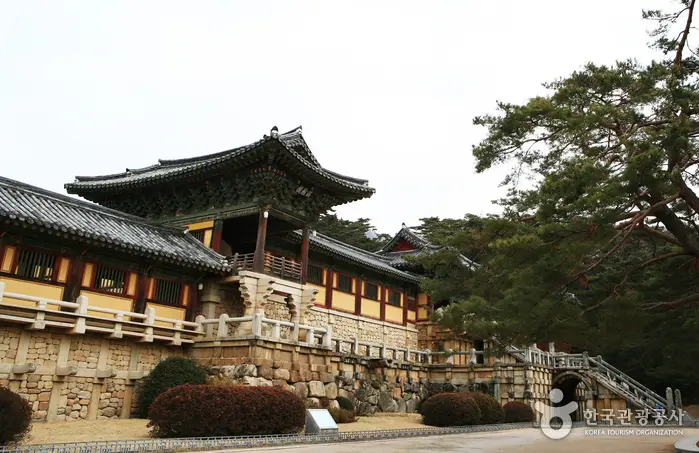
Encountering Gyeongju's Finest Cultural Heritage
3 stops · 6 hours
There is no doubt that Bulguksa Temple and Seokguram Grotto, on the slopes of Mt. Tohamsan in Gyeongju, rank among Korea's foremost cultural treasures. Inscribed together on the UNESCO World Heritage list, Bulguksa and Seokguram are an essential stop in Gyeongju, offering a glimpse of the essence of Silla-era Buddhist culture. Beyond Seokguram, at the Jangheung-ri temple site, you can see the five-story stone pagoda regarded as a masterpiece of the Unified Silla period.
- Duration
- 6 hours
- Distance
- 18km
Along the way
- 1Bulguksa Temple
불국사
Sitting midway up Mt. Tohamsan (745m) -- whose name means \"the mountain that drinks in and exhales clouds\" -- Bulguksa and Seokguram stand at the heart of Silla's brilliant Buddhist culture. They were first built 1,440 years ago, in the 22nd year of Silla King Beopheung, at his mother's wish, to pray for the stability of the nation and the peace of its people, and were later rebuilt and given fresh grandeur under Prime Minister Kim Dae-seong during the reign of King Gyeongdeok (742-764). \nMoreLess
- 2Seokguram Grotto
석굴암
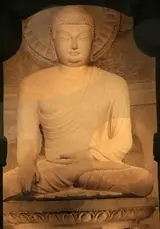
Seokguram, National Treasure No. 24, is said to have been founded in the 10th year of Silla King Gyeongdeok by the then prime minister Kim Dae-seong. Reached by a 3km mountain trail from Bulguksa or a 9km paved road, Seokguram's structure harmonizes square and circular forms, straight and curved lines, and flat and spherical surfaces; the 38 carved figures around its walls are each a masterpiece in their own right, together expressing a profound philosophical and scientific sophistication, while at the center a white granite seated Buddha looks out over the East Sea. \nMoreLess
- 3
West Five-Story Stone Pagoda at Jangheung-ri Temple Site
장항리사지 서오층석탑
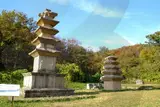
The Jangheung-ri temple site lies at the foot of a ridge running east from Mt. Tohamsan. As the temple's original name is unknown, it is called Jangheung-ri Temple Site after the name of the village. Today two pagodas remain, east and west, centered on the former Dharma hall site. The east pagoda had collapsed and lay scattered in the valley; its first-story body stone and five roof stones have been gathered and re-erected. The west pagoda, a five-story, 9m-tall stone pagoda on a double platform, had also collapsed and is currently undergoing restoration.\nMoreLess
Source: Korea Tourism Organization (TourAPI) · Machine-translated