In Search of King Munmu, Reborn as the Dragon of the Sea
6 stops · 7 hours
Crossing Mt. Tohamsan from downtown Gyeongju leads to a road tracing the footsteps of King Munmu, the architect of the unification of the Three Kingdoms, past temples such as Girimsa and Golgulsa. At Golgulsa, famous for Seonmudo martial arts, you can see a Buddha carved into the cliff face, then move on to the quiet, unassuming Girimsa, modest for its historic scale. Take in the sea of Gyeongju as you visit King Munmu's underwater tomb and Gameunsa Temple site, built by King Sinmun.
- Duration
- 7 hours
- Distance
- 31km
Along the way
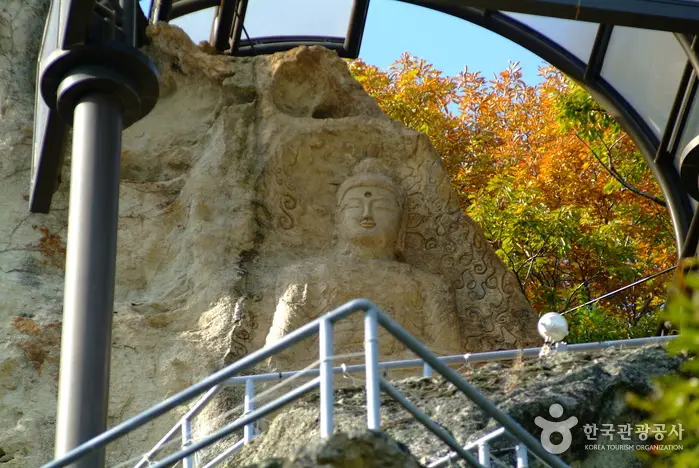
- 1Rock-Carved Seated Buddha at Golgulam, Gyeongju
경주 골굴암 마애여래좌상
Located in a valley near Girimsa, this rock-carved Buddha is the highest of 12 grottoes carved from a natural cave in the high cliff face at Golgulam. The Joseon painter Gyeomjae Jeong Seon depicted a wooden front hall in his painting \"Golgul Seokgul,\" but today only traces remain in the rock. Above the shaven head rises a tall topknot-shaped protrusion (yukgye); the clearly defined face, with its narrowed eyes, small mouth, and narrow, elongated nose, shows a more stylized, formal treatment than earlier works.\nMoreLess
- 2Girimsa Temple
기림사
Located on Mt. Hamwolsan in Yangbuk-myeon, Gyeongju, this Silla-era temple, with 16 buildings, is second in scale only to Bulguksa. Legend holds that it was founded in the early Silla period by the monk Gwangyu, a monk from India (Cheonchukguk). It was first called Imjeongsa, and was renamed Girimsa when Wonhyo expanded the temple grounds, though the exact date of its founding is unknown.\nMoreLess
- 3Gameunsa Temple Site
감은사지
Gameunsa (感恩寺) was a Silla-era temple that King Munmu, the 30th monarch of Silla, began building here after achieving the unification of the Three Kingdoms, intending through the power of the Buddha to repel Japanese pirate raids. He died before it was completed, and his son King Sinmun carried out his wish, finishing the temple in 682, the second year of his reign. \nMoreLess
- 4Tomb of King Munmu
문무대왕릉
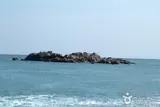
About 200m offshore from Bonggil-ri beach lies a rocky islet -- the underwater tomb of King Munmu (r. 661-681), the 30th ruler of Silla, who achieved the unification of the Three Kingdoms. On this 200m-round rocky islet, waterways were cut in a cross shape running east-west and north-south, forming a small pond-like basin at the center; it is believed that a large stone, 3.6m long, 2.85m wide, and 0.9m thick, was placed 2m below the water there to house the king's remains beneath it. \nMoreLess
- 5
Igyeondae Pavilion
이견대
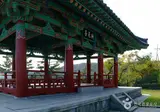
There are two places from which the King's Rock (Daewangam) can be meaningfully viewed: Igyeondae, in front of Daebon Elementary School, and the spot beneath the marker stone reading \"Donghaegu,\" where a monument inscribed \"My Unforgettable Sea\" stands. Igyeondae is the storied site where King Munmu, who gave up an elaborate royal tomb in favor of becoming a dragon guarding the East Sea, is said to have appeared in dragon form, and where his son King Sinmun is said to have obtained the priceless treasure Manpasikjeok, the flute said to calm all troubles.\n\nMoreLess
- 6
Songdaemal Lighthouse
송대말등대
Not far from Daewangam, the underwater tomb of King Munmu, who left the wish that even in death he would become a dragon guarding the East Sea after unifying the Three Kingdoms, lies the scenic harbor of Gampo. At the northern end of the harbor stands Songdaemal Lighthouse, watching over the vast expanse of the East Sea. Songdaemal is home to a lush pine forest some 300 to 400 years old.\nMoreLess
Source: Korea Tourism Organization (TourAPI) · Machine-translated