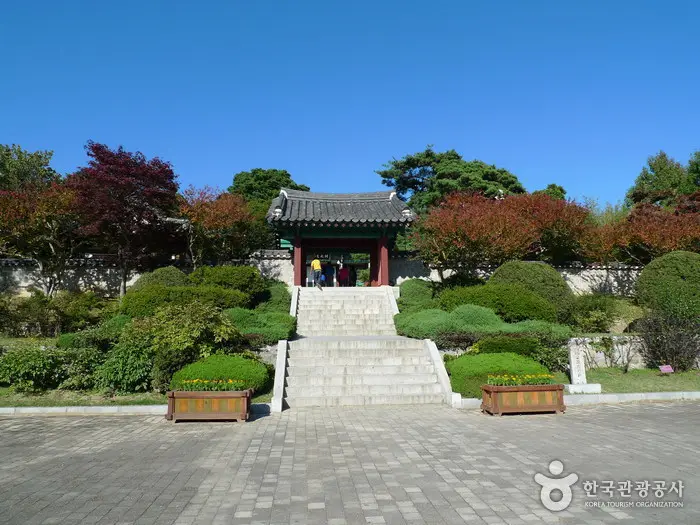
Cultural Heritage Tour: Meeting a Millennium of Gangneung's History
5 stops · 9 hours (incl. 4 hours of walking)
Gangneung is a region with a deep and diverse history spanning from prehistoric times to the Joseon Dynasty. Since the establishment of Haseulla-ju during the reign of King Jijeung of Silla, powerful local clans grew here during the Unified Silla period, and it also became home to the Sagulsan School, one of the Nine Mountain Schools of Seon Buddhism. It is a place home to many cultural heritages bearing major historical significance, including the National Treasure-designated Sammun Gate of Imyeonggwan Guesthouse in Gangneung, Gulsansa Temple Site, and Gangneunghyanggyo Local Confucian School.
- Duration
- 9 hours (incl. 4 hours of walking)
- Distance
- 44km (incl. 10km of walking)
Along the way
- 1Ojukheon House
오죽헌
Ojukheon House is a representative historical site in Gangneung that became famous in association with Yulgok Yi I, a prominent scholar of the Joseon Dynasty. As an early Joseon Dynasty architectural structure, Ojukheon was recognized for its architectural significance and designated as Treasure No. 165 in 1963. It is said that Yulgok Yi I was born in the Mongnyongsil Room here. \nWithin the grounds are Ojukheon, Munseongsa Shrine, the Sarangchae (men's quarters), Eojegak Pavilion, Yulgok Memorial Hall, and Gangneung City Museum. \nMoreLess
- 2Gangneunghyanggyo Local Confucian School
강릉향교
Hyanggyo were state-run educational institutions established across regions during the Goryeo and Joseon dynasties, responsible for ancestral rites for sages and Confucian education. Gangneunghyanggyo Local Confucian School was founded at its current location on Hwabusan Mountain in 1313 (the 5th year of King Chungseon) by Kim Seung-in, the Jonmusa of Gangneung. 1It underwent several repairs afterward, and having avoided damage during the Korean War, it retains its historic appearance. \nMoreLess
- 3
Sammun Gate of Imyeonggwan Guesthouse, Gangneung
강릉 임영관 삼문
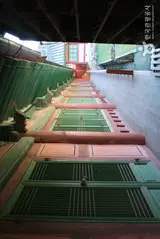
Yonggang-dong, Gangneung-si has long been the administrative center of this region, and a gaeksa was a facility where officials from the central government or distinguished guests were accommodated and entertained in the past. When it was first built, the name of the gaeksa was Imyeonggwan. The calligraphy on the current hanging plaque was written by King Gongmin in his own handwriting when he stopped by on his way to Naksansa Temple. The Gaeksamun Gate is a building in the jusimpo (column-head bracket) style, possessing a solemn beauty and sophisticated structure that are rare in Korea. Currently, only the Gaeksamun Gate remains. Among non-temple wooden structures, this Gaeksamun Gate is the oldest.\nMoreLess
- 4
Gangneung Gulsansa Temple Site
강릉 굴산사지
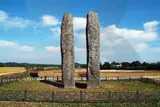
Gulsansa Temple Site is located about 6km southwest of downtown Gangneung. Founded in 847 (the 9th year of King Munseong of Silla) by National Preceptor Beomil, the temple was one of the 9 head temples among the 5 Doctrinal and 9 Mountain Seon schools of Silla Buddhism. The exact time Gulsansa was abandoned is unclear, but it is presumed to be around the late Goryeo or early Joseon period. Currently, the Stupa at Gulsansa Temple Site (Treasure No. 85), Flagpole Supports at Gulsansa Temple Site (Treasure No. 86), and Seated Stone Buddha at Gulsansa Temple Site (Cultural Heritage Material No. 38) remain here. \nMoreLess
- 5
Daegwallyeong Old Hill
대관령옛길
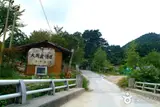
Daegwallyeong is a mountain pass between Gangneung-si and Pyeongchang-gun, standing at an elevation of 832m and stretching 13km in length. It can be considered a strategic transportation hub connecting the Yeongdong and Yeongseo regions, a conduit for cultural transmission, and a natural boundary. \nDaegwallyeong Old Hill is a section of the old Yeongdong Expressway that has now become a local road. Although it has become a quiet road with fewer visitors, it still boasts outstanding scenery, holds faint memories across each of its ninety-nine bends, and has a length of 19.1km.\nMoreLess
Source: Korea Tourism Organization (TourAPI) · Machine-translated